Always rework my examples on your own BEFORE attempting the homework.
Also see the examples Newton–Gregory Interpolating Polynomials. It contains Example 1 (worked in class). YOU SHOULD WORK EXAMPLE 2 YOURSELF.
However, this document does NOT cover all the details I discussed in class! So if you missed class, you should work all of Example 2 and obtain the lecture notes from a classmate to check your steps.
- Work Example 2 in the lecture notes on your own. Here are the
answers you should obtain.
- Construct the difference table for the following data from Gerald and
Wheatley:
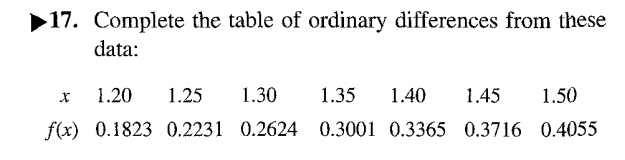
- Construct the Newton–Gregory interpolating polynomial that contains the 3rd, 4th,
5th, & 6th points. Use it to estimate f (1.37). Use the telescopic property to compute the binomial coefficients.
Answer: f (1.37) ≈ 0.314816000
- What is the interval of interpolation for the polynomial in
Part (a)?
Answer: [1.30, 1.45] or 1.30 ≤ x ≤ 1.45 - Use the "next term rule" to estimate the interpolation error in
Part (a).
Answer: Error ≈ +0.00000224 - Estimate the error in Part (a) in parts per million.
Answer: Error ≈ 7.11 ppm
- Construct the Newton–Gregory interpolating polynomial that contains the 3rd, 4th,
5th, & 6th points. Use it to estimate f (1.37). Use the telescopic property to compute the binomial coefficients.
- Suppose we construct the polynomial through points labeled 0, 1, 2, & 3.
- What degree polynomial do we expect to obtain?
- What degree is the polynomial if
Δ3f0 =
0?
What does that say about the 4 points?
- Suppose we construct the polynomial through points labeled 2, 3, 4, 5, & 6.
- What degree polynomial do we expect to obtain?
- What degree is the polynomial if
Δ4f2 = 0?
What does that say about the 5 points? - What degree is the polynomial if
Δ3f2 = 0
and
Δ4f2
= 0?
What does that say about the 5 points?
- Refer again to the data in Problem 2. Using x = 1.30 as the
first abscissa, approximate
f(1.33) by a 3rd degree polynomial. Use the telescopic property to compute the binomial coefficients. Also estimate the interpolation error.
Answers: f (1.33) ≈ 0.2851760
Error ≈ – 0.0000033600- Estimate the error in parts per million.
Answer: Error ≈ − 11.8 ppm
- Estimate the error in parts per million.
- Use the following data from Gerald and Wheatley to answer the stated
questions..
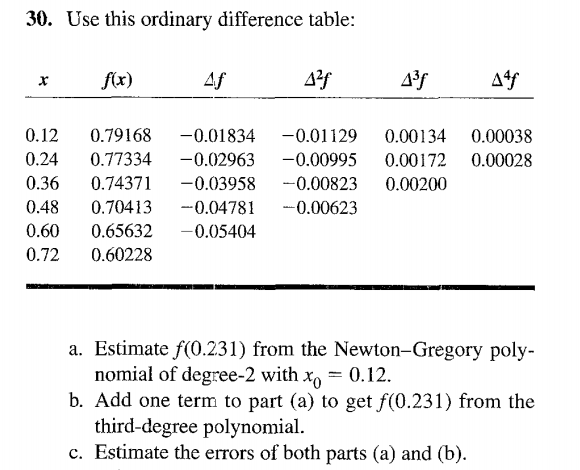
Answers:
- 0.77510 71218 75000 Error ≈ 0.00001 66557 81250 or 0.214 permyriad
- 0.77512 37776 56250 Error ≈ − 0.00000 24502 02148 or − 3.16 ppm
the amount of work that would be involved IF we were to use brute force algebra instead.
